Your Google Shopping Feed Is Already Powering ChatGPT

Eighty-three percent of the products ChatGPT recommends in its shopping carousels come directly from Google Shopping data. Researchers at analyzed 43,000 carousel products across 10 verticals and found that ChatGPT’s product recommendations, prices, and availability data closely matched Google’s top organic shopping results. They even discovered base64-encoded Google Shopping parameters hidden in ChatGPT’s source code, which is about as close to a smoking gun as you’ll find in search research.
Your Google Merchant Center feed now serves as the source of truth for ChatGPT, Google Gemini, Perplexity, Microsoft Copilot, and Amazon Rufus. Google’s AI Overviews, powered by Gemini, now reach over 2 billion users monthly embedded in standard search results, while ChatGPT serves 900 million weekly active users and ranks as the fifth most visited website on the planet. Gartner projects that by 2028, AI agents will intermediate 90% of B2B buying, pushing over $15 trillion in spend through agent exchanges.
The shift is underway. When and The Pixel surveyed more than 800 shoppers in January 2026, 10.5% said they already use AI tools like ChatGPT and Gemini as a discovery channel that leads to purchases. That number represents the floor, not the ceiling, and it should prompt every brand selling online to ask whether their product feed was built for this expanded role.
The honest answer for most brands is no. Most feeds were built to pass Google’s compliance checks and keep products approved. They were never designed to serve as the context layer that AI agents reason over, compare against competitors, and use to make purchase decisions on behalf of shoppers. That gap between what the feeds were built for and what they’re now being asked to do is where revenue starts to leak.
83% Of ChatGPT’s Product Carousel Recommendations Are Sourced From Google Shopping Data.
From Compliance Checkbox To AI Contract
For years, product feed management has been treated as an operational task, to match Google’s spec, avoiding disapprovals, uploading on schedule, and moving on. That approach was sufficient when the feed’s only job was to get your products listed on Google Shopping. Now that the same feed is powering purchase decisions across a growing network of AI agents, where agentic commerce means AI acting on behalf of shoppers to research, compare, and purchase products with partial or full autonomy, maintaining the status quo leaves you exposed.
Consider what happens when a shopper asks ChatGPT, “What’s the best waterproof hiking boot under £150 that arrives by Friday?” The agent reasons through structured feed data across dozens of merchants in seconds, evaluating price, shipping speed, product attributes, availability, and reviews. If your feed doesn’t have explicit answers to each of those questions, you aren’t in the consideration set, and the shopper never knows you existed.
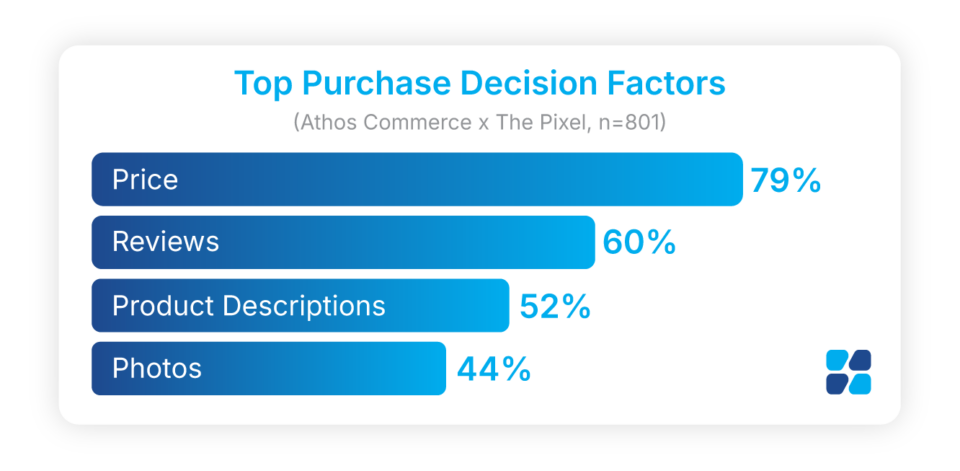
The Athos Commerce and Pixel survey confirms that AI agents are evaluating the same factors shoppers already care about, just faster and with less tolerance for gaps. The top four purchase decision factors among the 800+ shoppers surveyed were price (79%), reviews (60%), product descriptions (52%), and photos (44%). Every one of those is a product data problem. A human shopper who encounters a missing description might click away, while an agent eliminates you from the results before anyone sees your name.
Product feeds are shifting from basic attribute lists to intent-driven data designed for AI shopping agents. The data quality problems that brands have tolerated for years, from short titles to missing attributes to single product images, are about to be amplified. Agents have zero tolerance for ambiguity, and what used to cost you a few lost clicks now costs you visibility across every AI-powered surface your customers use.
This is where two emerging disciplines become critical. Answer Engine Optimization (AEO) is the practice of structuring your product data so that AI assistants like Siri, Alexa, and Google Assistant can extract direct, confident answers to shopper questions. Generative Engine Optimization (GEO) goes further, optimizing your content and product data so that generative AI tools like ChatGPT, Gemini, and Perplexity surface your products in their recommendations and citations. Both disciplines share a common foundation: the same structured product data that feeds Google Shopping now determines whether your products appear when AI agents answer a shopper’s question on your behalf.
Five Data Failures That Make Your Products Invisible To Agents
When your feed lists a product at £49.99 but your site shows £54.99, an AI agent won’t display a different price or flag a warning. It drops you from consideration entirely because a price mismatch signals unreliable data. This is the most damaging of the five feed failures that Athos Commerce identified during its , and Google is pushing merchants toward the Merchant API specifically to keep pricing and availability in sync.
The remaining four failures compound the problem.
- Incomplete or missing attributes, such as material, fit, and care instructions, leave agents unable to compare your products against competitors, forcing them to either hallucinate an answer or skip you altogether.
- Generic or duplicate titles like “Blue Shirt” get lost in conversational queries where specificity determines relevance. In one Athos Commerce feed audit, 85% of products had titles too short for AI discoverability.
- Poor image quality or single product images create a visibility gap because multimodal AI vision models now cross-reference text claims against photos. The 2026 benchmark for Google Shopping is 1500x1500px minimum with at least three images, including lifestyle context.
- Inconsistent variant data across size, color, or spec fields prevents agents from making a confident recommendation. Agents will surface a competitor with cleaner data instead.
These failures have always had a cost, but the penalty is changing. The Athos and Pixel survey found that 80% of shoppers have abandoned a site because they couldn’t find what they were looking for. Agents take that abandonment decision further upstream by filtering products out of results before any shopper has the chance to see them, which means the revenue loss happens silently and at scale.
The Trust Stack (And Why Agents Won’t Buy Without It)
Once your products clear the data quality bar, the next challenge is getting an agent to complete the purchase. During the , Stephanie Brown introduced what she called the Trust Stack, the feed attributes that move an AI agent from recommendation to checkout. Agents are programmed to minimize risk for the user, and without these signals, a rival who provides them will get the recommendation instead.
“We are no longer ticking boxes for approval. We are building the knowledge base for our future AI sales force.”
Stephanie Brown, Head of Product, Athos Commerce
The Trust Stack has three core elements.
- Free shipping indicators serve as a primary filter for agents evaluating purchase options. Athos Commerce research shows that free shipping data in the feed improves conversion by 2% on average.
- Shipping speed answers what has become a top-three agent query, “When will it arrive?” If your feed lacks an explicit shipping speed, a competitor whose feed includes one will win the recommendation, particularly for time-sensitive purchases.
- Return policy transparency removes what Athos calls the “what if” from the agent’s decision matrix. Clear return data embedded in the feed increases average order value and conversion by 3% because agents can commit to the purchase with full confidence that the buyer is protected.
Two additional signals serve as deal-closers when an agent compares similar products across multiple retailers. Submitting sale price annotations triggers a deal signal that can drive a 12.3% conversion uplift, and including product ratings in your feed drives a 5% increase in click-through rate.
Reviews deserve special attention within the Trust Stack because AI agents perform sentiment synthesis, reading the actual text of reviews to answer detailed queries like “Find me a black sparkly dress for a summer ball in London that fits true to size.” The Athos and Pixel survey found that 76% of shoppers already rate reviews as important or very important, with written reviews (58%) far outweighing star ratings alone (15%). If your feed lacks integrated review data, you pay what the Athos team calls the “trust tax” in lower visibility. The agent will source social proof from Reddit or a third-party blog instead, leaving you with no control over the narrative.
The review attributes that matter most for agent readiness are your aggregate product rating, the total review count (agents trust 500 reviews far more than five), and whether reviews are flagged as verified purchases, since agents are increasingly trained to filter out bot-generated and hallucinated sentiment.
Friction is the enemy of the shopping agent. If a human has to step in to verify a shipping cost, check a return window, or read reviews on a third-party site, you’ve failed the agentic checkout test. The goal is to make your data so complete that the agent can act with full confidence on the shopper’s behalf.
What To Do Now
Preparing for agentic commerce doesn’t mean rebuilding everything at once. For most brands, the distance between where their feed is today and where it needs to be is wider than one sprint can cover. The better question is “what do I do first?”
Tier 1: Fix the five data quality failures. Price mismatches, missing attributes, short titles, single images, and broken variant data are the issues that get you filtered out of AI results entirely. No amount of strategic feed work matters if agents are disqualifying your products at the data quality stage. For most teams managing this manually, titles and attributes are the highest-impact, lowest-complexity place to begin, especially if you’re running a catalog of fewer than 5,000 SKUs.
Tier 2: Add the Trust Stack signals that close the sale. Once your data is clean, add the fields that move agents from recommendation to purchase. Free shipping indicators, explicit shipping speed per product, and return policy data embedded in the feed rather than buried on your website. These three fields have a measurable impact on whether an agent completes the recommendation, and they’re faster to implement than most attribute-enrichment work.
Tier 3: Bring your reviews into your feed. Structured review data, including aggregate ratings, total review counts, and verified purchase flags, is what agents use to answer the detailed shopper queries that drive high-intent purchases. If your reviews live only on your website and aren’t in your feed, you’re ceding that context to Reddit and third-party blogs. If you don’t have reviews on your site at all, make that a Q2 priority.
On the horizon. Migration to the Google Merchant API for real-time pricing and stock sync, A/B testing at the SKU level, and preparing for emerging agentic checkout protocols like Google’s Universal Commerce Protocol are all worth planning for. UCP is currently invitation-only in the United States, but brands with their data architecture in place today will be first in line when it opens to general availability. If you’re stretched thin, the three tiers above will move the needle while you plan for what’s next.
None of this is trivial for teams already stretched thin managing feeds across multiple channels. Doing it manually for thousands of SKUs takes weeks, and by the time you finish, the feed has drifted again. During the , the Athos Commerce team demonstrated how their AI-powered feed audit completes that analysis in minutes, ranking every attribute shortfall by its impact on visibility and generating recommended fixes. In one Valentine’s Day A/B test, adding intent-driven product highlights produced a 120% increase in clicks, and those gains compound across every AI-powered surface where the enriched data appears. Athos Commerce’s Channel Assistant and GEO Assistant, part of the company’s feed management and intelligent discovery platform, handle the ongoing work of feed quality monitoring, catalog enrichment for AI agents, and syndication across Google Gemini, ChatGPT, and emerging AI platforms.
The brands that treat product data as a strategic AI asset will own the next era of commerce. Eighty-three percent of ChatGPT’s recommendations already come from your Google Shopping feed, and every AI agent entering the market is drawing from the same well. Your feed represents you whether you’re ready or not.
Watch the full webinar for live demos of the Athos Commerce AI-powered feed audit and data enrichment tools, plus a complete overview agentic commerce landscape. Watch the webinar on demand here →
Want more like this?
Want more like this?
Insight delivered to your inbox
Keep up to date with our free email. Hand picked whitepapers and posts from our blog, as well as exclusive videos and webinar invitations keep our Users one step ahead.
By clicking 'SIGN UP', you agree to our Terms of Use and Privacy Policy


By clicking 'SIGN UP', you agree to our Terms of Use and Privacy Policy
Other content you may be interested in

Categories


Categories


Want more like this?
Want more like this?
Insight delivered to your inbox
Keep up to date with our free email. Hand picked whitepapers and posts from our blog, as well as exclusive videos and webinar invitations keep our Users one step ahead.
By clicking 'SIGN UP', you agree to our Terms of Use and Privacy Policy
Brought to you by